The impossible equation of the small, economical car (1975-1981)
The VBG program: In search of the R4's successor
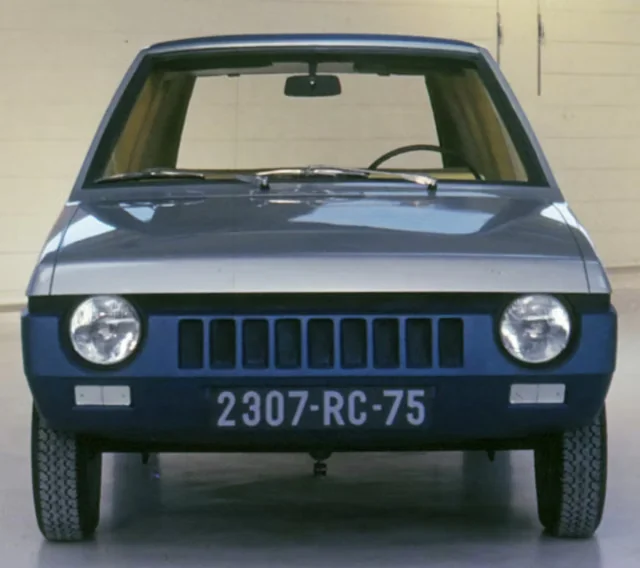
The history of the Twingo has its roots in the mid-1970s, when the Régie Renault launches in 1975 the research program VBG For Low-End Vehicle.
The general staff's objective was then clear but extremely complex: to design a very economical vehicle capable of eventually replacing the legendary Renault 4, while inserting itself beneath the Renault 5 launched three years earlier. At that time, the design office was exploring very basic formulas. The first VBG prototypes sported angular lines, rudimentary aerodynamics, and small-displacement twin-cylinder engines. The VBG program was developed through successive projects and models: X40, X49, Z, X44, and X45.
The economic impasse and the lessons of the oil shock
In the wake of the second oil crisis of 1979, the need to produce an ultra-fuel-efficient city car became an absolute priority. However, as Christophe Bonnaud, a journalist specializing in automotive design, points out, the VBG program ran into an insurmountable financial contradiction: the manufacturing cost of a very small car was almost equivalent to that of a larger, more versatile city car, while its final selling price absolutely had to remain very low. Projected profit margins were negative. Unable to make the vehicle profitable, management put the project on hold in the early 1980s.
The temptation of the urban minivan: W60 projects under study 126 (1981-1986)
The "Space" effect and the single-volume variation
In the early 1980s, Renault developed in partnership with Matra what would become the Renault Espace (launched in 1984). The minivan architecture — where the engine hood and windshield are in the same continuous alignment — appeared as a revelation.
According to contemporary archives examined by Auto-Journal, the style teams Renault They decided to adapt this formula to a small city car. This was the birth of the project. W60 in 1981. By eliminating the clear separation between the engine compartment and the passenger compartment, designers realized they could offer spectacular living space in a limited exterior footprint.
Marcello Gandini's intervention and the "Need 126" project«
The program evolved in the mid-1980s under the name «"Need 126"» (then N60). The goal was to find a modern equivalent to what the 4CV or the R4 were in their time. To overcome the stylistic impasse, Renault called upon prestigious external consultants, foremost among them the Italian designer Marcello Gandini, famous father of Lamborghini Miura And Countach.
In retrospective surveys published by L'Argus Automobile, We discover that Gandini is proposing a series of very daring minivan models, characterized by a steeply raked windshield and minimal overhangs. While Gandini's proposal is considered architecturally appealing, it still lacks the roundness and charm necessary for a popular entry-level vehicle.
The rejection by the steering committee and the freezing of the program
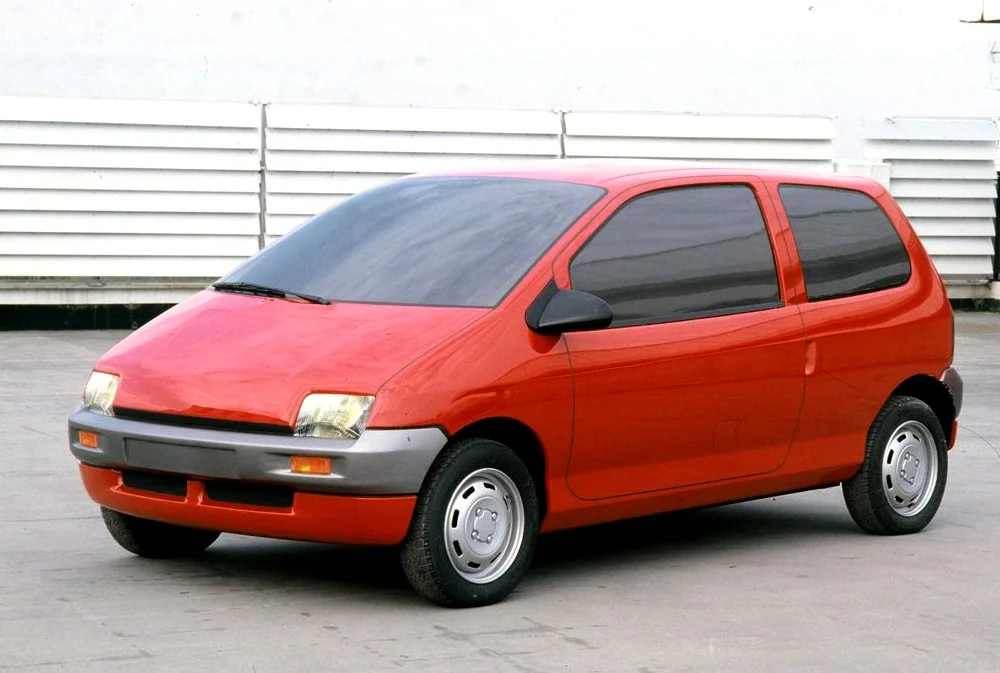
In 1986, Renault's financial situation was critical. The group recorded massive operating losses, and the new CEO, Georges Besse, then his successor Raymond Lévy, They imposed drastic budgetary constraints. The model of Project 126 was presented to the company's management: the verdict was swift and brutal. The car was deemed drab, strange, and commercially too risky. The project was once again shelved, nearly abandoned altogether.
The turning point and the metamorphosis: The X06 project (1987-1992)
The arrival of Patrick le Quément and the rediscovery of the project
The historic turning point comes in the fall 1987. Patrick le Quément is appointed Director of Industrial Design of Renault. He recalls how, during his tour of the workshops at the Boulogne-Billancourt style center, he stopped in his tracks in front of a dusty model of project 126.
Le Quément immediately grasped the genius of the minivan silhouette, but identified its weakness: the vehicle sorely lacked soul and warmth. He convinced management to relaunch the project under the official code of Project X06. Faced with the recurring skepticism of the management committee, Le Quément sent CEO Raymond Lévy a memo that has become legendary in the history of industrial management:
«"The biggest risk for Renault is not taking any risks. I ask you to vote for instinctive design over analytical marketing."»
Convinced by this audacity, Raymond Lévy gave its final approval in 1989.
The rigor of Design to Cost according to Yves Dubreil
To make the X06 project profitable where all others had failed, Renault appointed the engineer Yves Dubreil at the head of the project division in order to apply the method of Design to Cost (target cost design):
- An ultra-simplified offer: A single 3-door body style, a single engine at launch (the tried and tested 1.2L Cleson-Fonte block), a single trim level and four unique bright colors (Indian Yellow, Coral Red, Coriander Green, Ultramarine Blue).
- Drastic reduction in diversity: The absence of complex options makes it possible to optimize the assembly line of the Flins factory and to compress the selling price below the symbolic threshold of 55,000 French francs.
- The sanctuary of innovation: The savings made on the mechanics allow for massive investment where the customer perceives the added value: the sliding rear bench seat (17 cm), capable of transforming the passenger compartment into a truly modular lounge.
Jean-Pierre Ploué's pen stroke: The invention of the gaze
Within the design studio, the exterior style is entrusted to the young designer. Jean-Pierre Ploué whose mission was to transform a potentially utilitarian, single-body volume into an endearing and playful silhouette, under the aegis of Patrick le Quément.
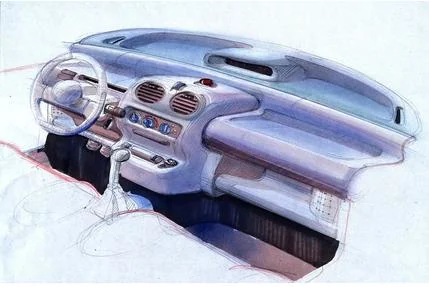
He fitted the front end with semi-circular headlights topped by hood vents reminiscent of nostrils, creating an anthropomorphic face of unprecedented expressiveness. The city car no longer resembled a cold vehicle, but a cartoon character. Inside, Gérard Gauvry designed a minimalist dashboard adorned with round, green control buttons (evoking sour candies) and a central digital display.
He fitted the front end with semi-circular headlights topped by hood vents reminiscent of nostrils, creating an anthropomorphic face of unprecedented expressiveness. The city car no longer resembled a cold vehicle, but a cartoon character. Inside, Gérard Gauvry designed a minimalist dashboard adorned with round, green control buttons (evoking sour candies) and a central digital display.
The shock of the 1992 World Cup and the commercial launch (1992-1993)
The tidal wave at Porte de Versailles
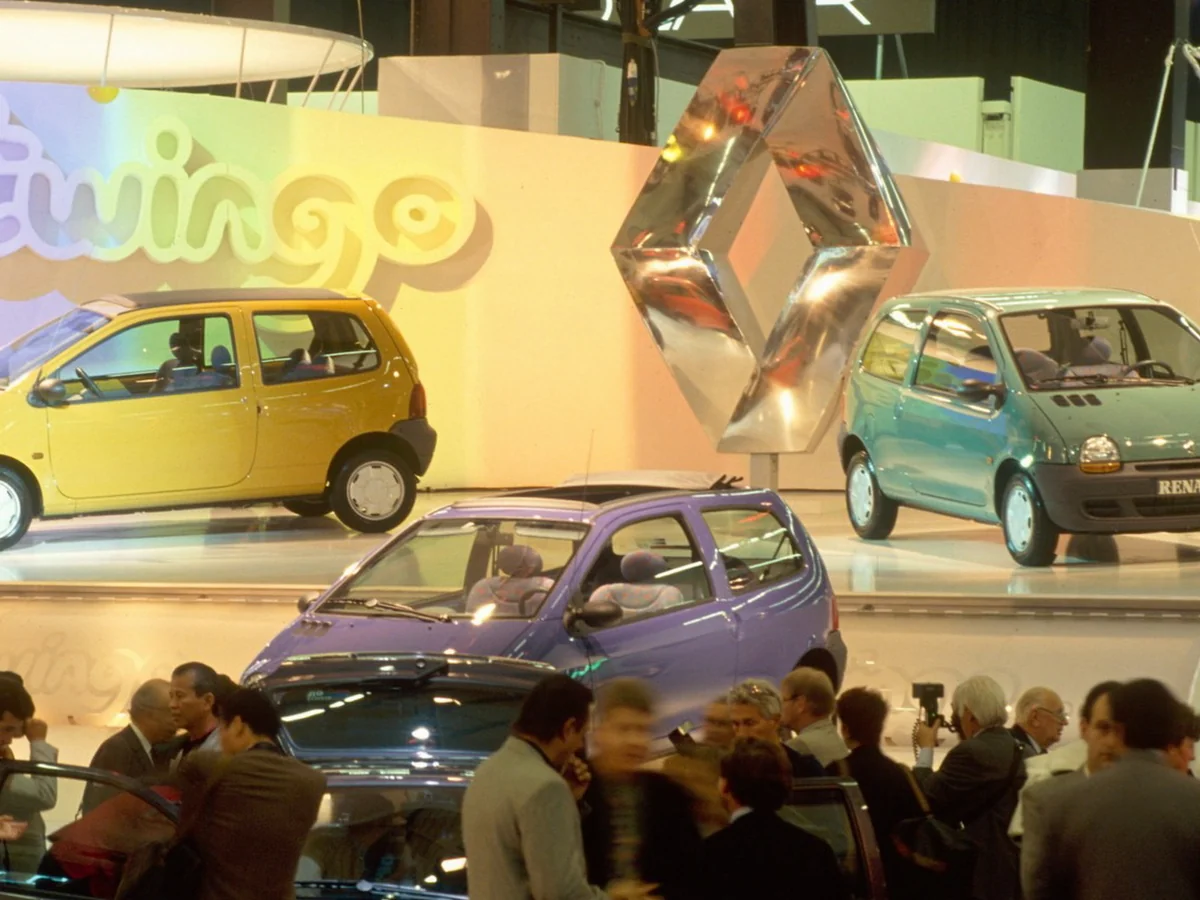
THE October 5, 1992, during the opening of the Paris Motor Show, the stand Renault creates a veritable media frenzy. The Twingo (a name invented by naming specialist Manfred Gotta, combining Twist, Swing And Tango) shocks as much as it amazes.
Observers in the international automotive press immediately hailed a stylistic break as striking as Alec Issigonis' Mini in 1959 or the Renault 4 in 1961. With its legendary advertising campaign designed by the illustrator... Philippe Petit-Roulet and the slogan «"It's up to you to invent the life that goes with it."», Renault imposes a joyful and unconventional communication style.
An industrial and sociological triumph
Launched in March 1993, the Twingo 1 instantly became a social phenomenon. Transcending social classes — adopted by young drivers, urban families, and the upper classes of upscale neighborhoods alike — it exceeded all of Renault's sales forecasts.
Produced at over 2.4 million copies On the European market until 2007 (and continued until 2012 in South America), the Twingo I demonstrated the accuracy of Patrick le Quément and Yves Dubreil's vision: to transform an economic constraint into a masterpiece of ergonomics and design.
Want to learn more about the faces behind the X06 project?
🎥 To learn more: Visual Archives & Videos
To visualize the concrete evolution of the clay models, the VBG and W60 prototypes, and even the secrets of the X06 project, consult the well-documented video report produced by the journalists of L'Argus :
🎬 Discover the history of the Twingo through its models (L'Argus) ➔