
Hence the importance of proper valve clearance adjustment.
1. Ensure sealing and performance
- Complete closure: If the valve clearance is too small (the valve is "sticking"), the valve does not close completely. This results in a loss of compression, reduced power, and increased fuel consumption.
- Optimal filling: If the clearance is too large, the valve does not open fully or for long enough, which impairs air/fuel filling and exhaust gas evacuation.
2. Prevent valve damage
- The exhaust valve dissipates its heat mainly when it is in contact with the cylinder head (its seat).
- If the valve clearance is zero or insufficient, the valve remains slightly open. The extremely hot combustion gases escaping through this opening will literally scorch the material: this is what is called a burnt valve, requiring extensive repairs.
3. Limit mechanical wear and noise
- Game too big: Excessive valve clearance causes a characteristic metallic rattling noise. With each valve opening, the camshaft or rocker arm "hits" the valve stem instead of making gradual contact, which accelerates wear on the entire valve train.
In summary: Proper valve clearance ensures good heat transfer to prevent breakage, provides maximum compression to preserve performance, and protects the valve train from premature wear.
Data relating to Renault Twingo 1
| ENGINE | ADMISSION | EXHAUST |
| C3G | 0,20 | 0,25 |
| D7F | 0,10 | 0,20 |
| D4F | 0.05 to 0.12 | 0.15 to 0.22 |
Procédure de réglage du jeu aux soupapes
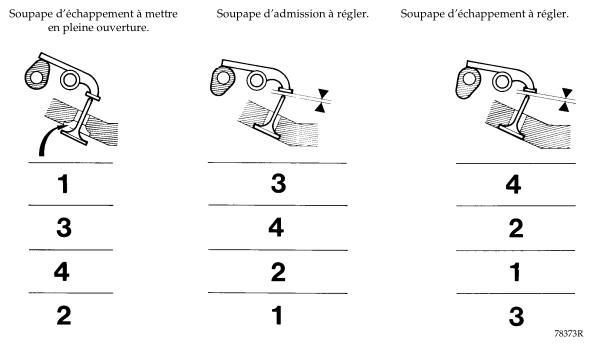
C3G engine
Suivre les indications du tableau suivant :
D7F engine
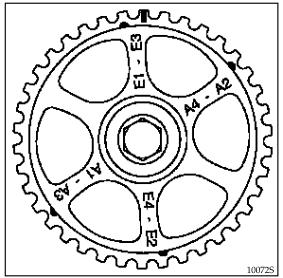
Placer le moteur au Point Mort Haut, cylindre N°1 en allumage. Tourner le vilebrequin dans le sens des aiguilles d’une montre (vue côté distribution) pour arriver au premier repère. Régler la soupape d’échappement N° 1 et N°3. Avancer jusqu’au repère suivant, comme indiqué ci-dessous.
D4F engine
Suivre les indications du tableau suivant :
Source : Renault documentation.