
This maintenance plan summarizes all the manufacturer's recommendations from the workshop documentation. Renault (MR 305) and the Automotive Technical Review (RTA) for Renault Twingo 1 models equipped with the 1.2L C3G engine (Cléon-Fonte block with timing chain).
1. Summary table: Fluids, capacities and periods
| Organ / Circuit | Ability | Recommendation & Original Standard | Current Equivalence | Maintenance frequency |
| Engine oil | 3.0 L (crankcase) + 0.5 L (filter) Total: 3.5 L | Multigrade oil depending on climate: 15W40, 15W50, 10W30, 10W40, 10W50, 5W30, 5W40, 5W50 Standards: CCMC-G4 / G5 (CEE) or API SG (Other countries) | 15W40 or 10W40 oil in ACEA A3/B4 and API SL, SM, SN or SP standard | Oil change every 10,000 km (or 1 year) (💡Tip: choose a low-viscosity oil such as 15W40 or 10W40) |
| Gearbox (JB1) | 3.40 L | TRANSELF B 80W Standards: API GL-5 or MIL-L-2105 C/D | 80W-90 oil in API GL-5 standard (e.g. Transself Type B 80W-90) | Lubricated for life: check the level every 20,000 km (💡 Tip: preventative oil change recommended) |
| Cooling system | 5.5 L | Glacéol AL (Type C) Protection down to -23°C (warm/temperate/cold climates) or -40°C (extreme cold). Top up with demineralized water only. | Type C liquid (mineral/silicate technology, type G11); avoid mixing with an organic Type D/G12 liquid without complete rinsing. | Check the fluid level every 10,000 km; change the oil and bleed the system every 2 years. |
| Braking circuit | 0.7 L | Synthetic DOT 3 fluid meeting SAE J 1703 standard (approved by engineering office) | Synthetic DOT 4 fluid (compatible with DOT 3 / SAE J1703, polyglycol base). | Check the fluid level every 10,000 km; change the oil and bleed the system every 50,000 km (or 2 years). |
| Fuel tank | 40 L | Super unleaded RON 95 or RON 98 (RON 91 mini according to RTA) | — | — |
2. Mileage and time-based maintenance schedule
Every 10,000 km or 1 year
- Engine oil change (3.5 L with filter),
- Oil filter: Replacement is essential at every oil change.,
- Levels and sealing: Checking coolant, brake fluid, and windshield washer fluid levels; visual inspection for leaks (engine, gearbox, shock absorbers, brake system). Checking the level and leak-tightness of the electric pump unit on the Easy-Clutch automated version.,
- Accessory belt (water pump / alternator): Condition check (cracks) and tension check (arrow of 2 ± 0.5 mm under a force of 3 daN between the water pump and the alternator),
- Accessory belt (air conditioning compressor): The check is identical to that of the water pump/alternator belt.,
- Safety and ground connections: Checking the wear of the front brake pads and discs, condition of the tires and pressures (including spare tire), inspection of the CV joint and rack boots, checking the exhaust system, battery and lighting.
Every 20,000 km
- Oil filter: Periodic replacement,
- Air filter: Replacement of the dry filter cartridge (more frequently in dusty atmospheres),
- Ignition: Replacement of 4 spark plugs ; inspection and cleaning of the distributor cap (delco), distributor rotor, and high-voltage wiring harness;,
- JB1 gearbox: Level control via the overflow filling port.
Every 50,000 km
- Fuel filter: Replacing the metal filter located under the body, just in front of the tank (respect the assembly direction indicated by the arrow on the body).,
- Brake fluid: Complete draining and purging of the hydraulic circuit in an «X» pattern.,
- Rear brakes: Dust removal from the drums and wear check of the linings and receiver cylinders.
No replacement interval (Lifetime / On monitoring)
- Distribution : Driven by a simple chain with automatic hydraulic tensioner — no periodic replacement required,
- Valve clearance (rocker arms): Checking and adjusting only in case of abnormal rattling noise or after work on the top of the engine.
3. Choosing engine oil viscosities according to climate
The Renault 305 repair manual distinguishes the permitted viscosity grades according to the minimum ambient temperature encountered:
- 15W40 or 15W50 (CCMC-G4 standard) : To be used only when the outside temperature does not fall below -15 °C,
- 10W30, 10W40 or 10W50 (CCMC-G5 standard) Versatile temperate beach, suitable from -20 °C and even during periods of intense heat (+30°C and above),
- 5W30 (CCMC-G5 standard) : Suitable for extreme cold (up to -30 °C and below), but not recommended above +20 °C,
- 5W40 or 5W50 (CCMC-G5 standard) : Covers the entire thermal spectrum, from -30 °C to more +30 °C.
4. Checks of wear dimensions and trigger values (Braking & Cooling)
During periodic inspections, the following measures are used to validate the conformity of the safety components:
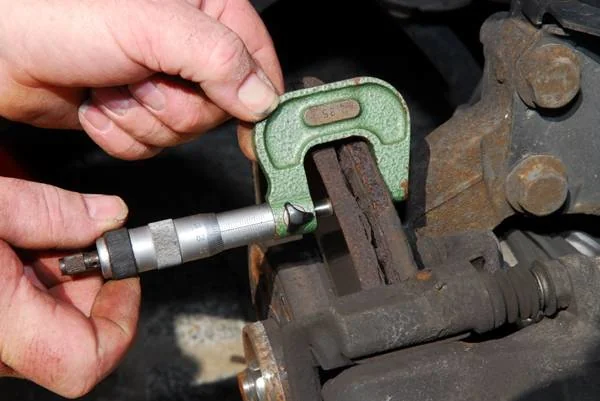
- Front brakes (solid discs Ø 238 mm):
- Nominal disc thickness: 8 mm | Minimum rating: 7 mm (correction prohibited),
- Maximum permissible disc sail area: 0.07 mm,
- Nominal thickness of the pads (including backing): 15 mm | Minimum thickness: 6 mm.
- Rear brakes (self-adjusting drum brakes):
- Nominal drum diameter: 180.25 mm | Maximum diameter after grinding: 181.25 mm,
- Nominal thickness of the linings (including backing): 6.5 mm | Minimum thickness: 2.5 mm (width: 40 mm).
- Cooling system:
- Pressure setting of the expansion tank cap valve: 1.2 bar (brown color marker),
- Thermostat: beginning of opening at 89 °C, full opening to 101 °C,
- Cooling fan thermal switch: activation at 83 °C, triggering at 90 °C.
5. Specific points of vigilance for the C3G engine
- Respect for the coolant (Glacéol AL Type C): The C3G engine combines a cast iron block with an aluminum cylinder head. When bleeding or topping up the system, use only demineralized water with Type C concentrate (or a Type C compatible fluid) to prevent internal corrosion and sludge buildup in the heater core.
- Sealing of the JB1 box (left-side bellows): On the JB1 gearbox, the driver's side (left) transmission boot directly seals the gearbox oil. Any tear or leak at the boot bearing necessitates an immediate gearbox oil change: this must be checked at every service.
- Sensitivity to ignition humidity: Since the mechanical distributor (distributor cap) is exposed at the front of the engine, regular cleaning of the inside of the cap and rotor during servicing prevents misfires and hard starting in wet weather.