
The Cléon Fonte engine, whose real name is "« Sierra engine »" also known under the code "C engine" or "C block", is an internal combustion automotive thermal engine, designed and manufactured by Régie Renault, in the early 1960s. It was presented at the Geneva Motor Show in 1962. It is renowned for its robustness and longevity.
This four-stroke gasoline engine features four inline cylinders with sleeved cylinders in a cast iron block and is water-cooled. It has a five-bearing crankshaft, a side camshaft with pushrods and rocker arms, and a single timing chain. Its cylinder head is made of aluminum and has eight overhead valves.
History
Preamble
Born in 1962, the Renault Cléon Fonte four-cylinder engine powered generations of models, increasing over the years from 956 cm3 to 1,565 cm3, from the Floride to the Twingo, via the Renault 11 Turbo and the Renault 5 Turbo 2.
A remarkable destiny for this engine which still powered our beloved Twingos at its launch in 1993, more than thirty years after its presentation at the Geneva Motor Show in 1962! At the time, the modern design of the "Sierra" engine was praised, soon renamed "Cléon-Fonte" after the ultra-modern Renault factory where it was first manufactured.
Technical adaptations allowed the production of this engine in numerous displacements, with single or twin-barrel carburetors, as well as with fuel injection, with or without a turbocharger. The "Cléon-Fonte" was coupled to four-speed manual gearboxes, then five-speed manual gearboxes, and automatic gearboxes, depending on its applications and the progress of automobile manufacturing.
It thus equipped an impressive list of Renault models (and others), in rear, central, front, transverse or longitudinal positions: Floride, Caravelle, Alpine A110, R4, R5, Le Car, Super 5, R6, R7 (Siete), R8/R10, R9/R11, Alliance/Encore, R12, R15, R18, R19, R21 (Export), Estafette, Trafic 1, Express (Rapid/Extra), Fuego, Twingo 1, Clio 1. Not forgetting the Dacia range from 1971!
It was from that year onwards that Renault extended the production of the "C" engine to the factory of its Romanian partner, in Pitești. In recent years, this four-cylinder engine was only used in these derivative commercial vehicles.
Finally, on November 29, 2004, Dacia produced the very last "C" engine in history. It was a 1.6 i with 68 horsepower bearing the serial number 2 527 155.
In total, more than 27 million "Cléon-Fonte" engines have been produced by Renault and Dacia since its launch, including 15 million in France. This engine has also been assembled in Portugal, Spain, Turkey, Colombia, and Argentina.
In France, this engine will end its career in December 1996 on the Twingo, Clio and Express with the 1,239 cm3 C3G, on the Super 5 "Bye Bye" with the 1,390 cm3 C3J and at the same time the end of production of the Super 5.
This four-cylinder engine has already achieved classic status in the hearts of French collectors. And, around the world, it survives under the hood of thousands of vintage Renaults, some lovingly preserved, others kept for practical purposes.
Design
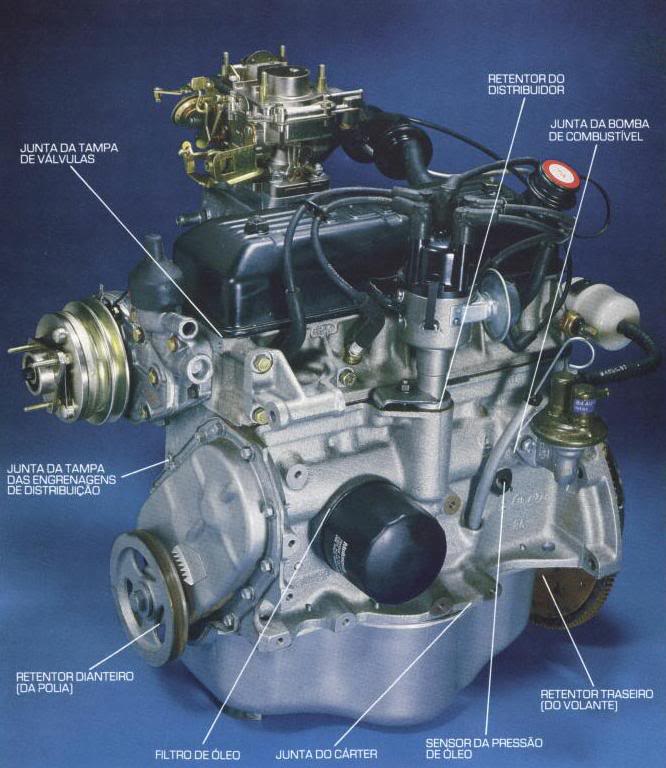
It all began in the late 1950s, when the Renault design office, headed by engineer Fernand Picard, decided to develop a more modern engine for the future Renault 8 than the 850cc "Ventoux" engine of the Dauphine. Engineer René Vuaillat designed a completely new small 4-cylinder engine, with a displacement to be increased from 956cc to 1108cc. Cast in iron and topped with an aluminum cylinder head, this engine was characterized by its camshaft positioned very high in the block and, above all, by its 5-bearing crankshaft. From the very first tests, it demonstrated excellent flexibility and, above all, more power than the 850cc "Ventoux," whose design dated back to 1944. It was christened "Sierra," because at that time at Renault, engines were not yet designated by letters, but by names. It was later that it acquired the nickname "Cléon Fonte", where it was manufactured, attached to "fonte" in order to distinguish it from the "Cléon-Alu" engine of the Renault 16, and finally "engine C".
Beginning
The cast-iron Cléon engine made its official debut at the 1962 Geneva Motor Show in the Renault Floride S, replacing the 850cc, 40hp engine of the Dauphine Gordini. This 956cc engine, which delivered around ten more horsepower, or 51hp according to SAE standards, was fitted a few months later to the new R8 sedan. In the meantime, in a mid-rear position, it had made its grand debut on the track, notably at the 24 Hours of Le Mans in the René Bonnet Djet, at the time the official Renault team.
Amédée Gordini was responsible for preparing it, fitting it with either a hemispherical cylinder head or a twin overhead camshaft cylinder head, allowing 85-90 hp in 1000 cc compared to 70 hp for the 700 version. Until 1963 in the Djet competition, it revealed some weaknesses affecting the rigidity of the block, leading to a definite propensity for cylinder head gasket failure, which prompted Renault to stiffen it slightly.
In 1963, it appeared in a 1,108 cc version, a displacement better suited to the Estafette van, where it was first mounted in a rear overhang configuration. Then, the Floride, still criticized for its somewhat timid performance, received it under its rear hood before powering the luxurious R8 Major in mid-1964. The 1,108 cc displacement, offering greater flexibility, was achieved by increasing the bore to 70 mm and creating different center-to-center distances between the cylinders.
Still competing, in the 1000cc twin-cam class, in addition to the Bonnet and Alpine prototypes, it powered their Formula 2 and 3 single-seaters, where it proved less than convincing. It found greater success in the 1108cc version with its attractive hemispherical cylinder head and twin ports, which was fitted as standard equipment in late 1964 on the sporty R8 Gordini. Fed by two large 40mm Solex carburetors, the 1108cc engine delivered 95 hp SAE, allowing a top speed of 170 km/h, demonstrating an undeniable explosive character that enabled it to power the Matra Djet and Alpine Berlinette. The work of tuners like Ferry, Amédée Gordini, and Mignotet increased its power to 100 hp, then 120 hp in the 1296cc version. The engine displacement would evolve to 1,440 cc and even 1,530 cc, developing up to 145 hp. These engines were rather short-lived, as there wasn't much metal left between the cylinder liners!
The pinnacle
In the late 1960s, the cast-iron Cléon engine was Renault's all-purpose engine. Installed in the R8 and R10, popular sedans of the time, as well as the Estafette van, it was also produced in Valladolid, Spain. At the end of 1966, to power the new R8 Gordini 1300, it received a new block with uniform cylinder spacing and a specific crankshaft with a lateral offset, this time displacing 1,255 cc and producing 88 hp DIN.
In late 1969, Renault launched its front-wheel-drive R12. Now designated "C," the "Cléon-Fonte" engine returned to service in a front-mounted configuration, extensively reworked to produce 1,289 cc and 54 hp DIN, and with a return to uniform cylinder spacing. Despite its remarkable flexibility, it was no longer powerful enough to power the sporty versions of the R12 and Alpine Berlinette. In this 1,289 cc displacement, it equipped the Estafette van, the R12, and the R15 TL coupé, producing 60 hp. But it was the 956 cc engine that made a comeback, mounted longitudinally at the front and coupled to a new gearbox, first under the hood of the Renault 6, and then primarily in the R5 TL.
From then on, this small sedan was to represent the Renault brand in racing. To achieve this, Renault essentially repeated the work done by Gordini 10 years earlier, but at a much lower cost. Enlarged to 1,397 cc, the "Cléon Fonte engine," fitted with a new hemispherical cylinder head, produced 93 hp in the 1976 R5 Alpine before increasing to 110 hp in the 1981 R5 Alpine Turbo.
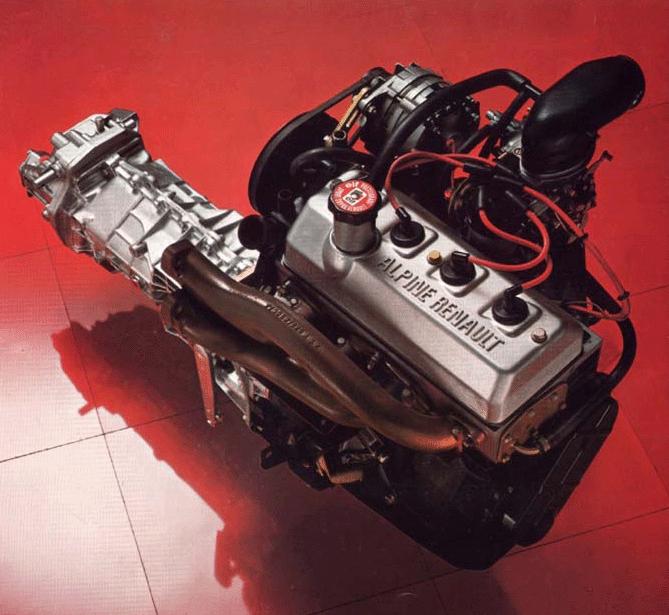
Meanwhile, it had been fitted to the R4 GTL with a 1,108 cc engine before the base model, which retained its old 850 cc three-bearing "Billancourt engine," also received it, but in a 956 cc version, in 1986. In a 1,397 cc version, fitted with a standard cylinder head and offered in several power outputs, it found its way under the hood of the R18, which succeeded the R12. It was in this displacement, but mounted transversely at the front, that it reappeared in 1981 under the hood of the R9, voted "Car of the Year 1982," and its sister car, the R11, in 1983, then under the hood of the Super 5 in 1984.
The Renault 9 and Renault 11 were pivotal models for Renault, as they introduced a new technical platform that would be used on many models. Indeed, their chassis was reused on the Renault 19, Mégane 1, and Scénic 1, and derived for the Super 5, Express, Clio 1, Clio 2, Kangoo 1, and Twingo 2. The Renault 9 and Renault 11 were the first cars to use a Renault engine in a transverse position, which led to the development of the JB gearboxes that would later be used in the Twingo 2. The "F engines" that appeared in the Renault 9 and Renault 11 would also power the Mégane 3, notably the F4RT in the Mégane 3 RS.
The "Cléon-Fonte engine" had already been in production for 20 years! With its side camshaft and 8 valves, it was already showing its age compared to its younger competitors. But, constantly improved, it remained competitive. And that was without taking into account the turbocharger, a miracle component generating horsepower!
In late 1980, thanks to a large turbocharger, it delivered an impressive 160 hp to the rear wheels of the spectacular R5 Turbo. Mounted in a mid-rear position for the first time, this 1,397 cc engine was coupled to the large gearbox from the R30 TX. In rallying, the Group B R5 Turbo saw its power gradually increase from 200 to 300 hp, peaking at 360 hp in the 1,527 cc Maxi version of 1985, before approaching 400 hp (385 hp to be exact) in 1987 on the circuit versions of the Superproduction championship. This engine benefited from the technology of the 1500 turbo from Formula 1, notably water injection into the intake. Astounding power for an engine with such a dated design, but one that, admittedly, no longer had much in common with the original block.
End of career
After powering the basic R19 and Clio 1, everyone thought in the early 90s that this engine, which had adapted not so badly to anti-pollution standards and the catalytic converter, was nevertheless living its last days, with the arrival of the "Energy engine".
When the Renault 14 was launched in 1976, it was thought that the "Cléon-Fonte engine" would disappear, as it was equipped with the "X engine" from Société Française de Mécanique, shared by Peugeot and Renault (an engine also used in Peugeot, Talbot, and Citroën models). This "hybridization" with its main competitor at the time was reportedly poorly received by customers and the Renault service network. Consequently, for the Renault 9 and Renault 11, intended to replace the Renault 14, Renault returned to its "Cléon-Fonte engine," which was already considered outdated with its side camshaft, as early as the 1980s. The Renault 9 gave this engine a second life; it was the first car to use a Renault engine in a transverse position, meaning the "Cléon-Fonte" was mounted transversely under the hood for the first time, coupled to the JB gearbox.
It was almost as if it had been written off for good when the Twingo appeared in 1993, marking its return to the scene, this time with a larger 1239cc engine, specifically for the Twingo 1. Journalists heavily criticized the Twingo for using this old engine. Indeed, the "Energy engine" from the Renault 19 and Clio, with its hemispherical cylinder head that placed the exhaust at the front, simply couldn't fit under the hood of the small Twingo. Until the end of 1996, still going strong, it did a perfectly adequate job in this city car before finally giving way to the brand new, more modern 1149cc "D engine" (type D7F). The D7F engine simultaneously replaced the 1.2 "Cléon-Fonte" engine in the Twingo and the 1.2 "Energy" engine in the Clio. The "Cléon-Fonte" engine will continue to be manufactured by Dacia until the end of 2004, to equip the Berlina models derived from the R12!
Engine displacement
The Renault Cléon Fonte engine was available in the following main displacements:
| KIND | ENGINE DISPLACEMENT (cm3) |
| 689 – C1C | 956 |
| 688 – 804 – C1E | 1108 |
| C1G | 1237 |
| C3G | 1239 |
| 812 | 1255 |
| 810 – C1H | 1289 |
| 804 | 1296 |
| C3J | 1390 |
| 840 – 847 – C1J – C2J – C3J – C6J – C7J | 1397 |
| C7K | 1430 |
Do you own a Twingo equipped with the C3G engine? Visit our shop and discover all our parts for the Cléon Fonte engine!
Sources: Renault documentation, Wikipedia and cleon-fonte.forumactif.com