
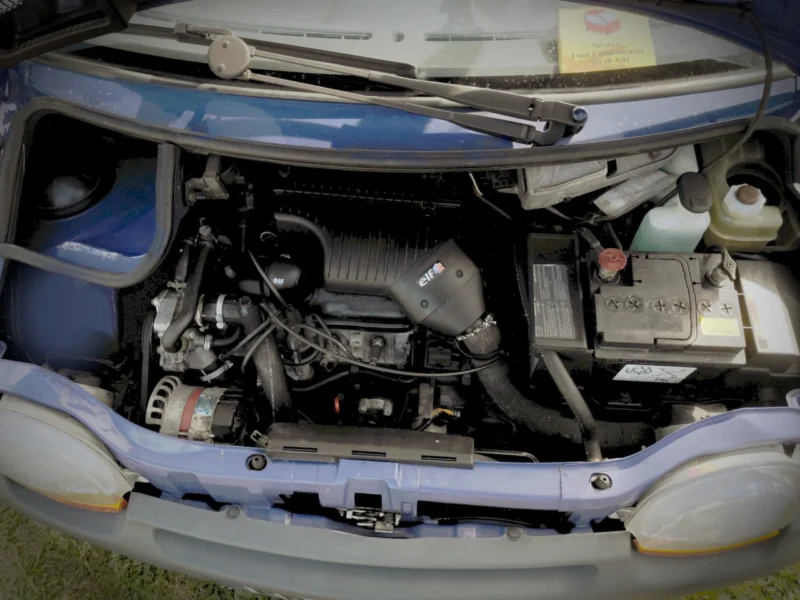
With a displacement of 1239 cm3, and modernized on part of its moving parts and cylinder head, the Cléon Fonte engine, the first engine of the Twingo 1, is equipped, within the Twingo, with single-point electronic injection and electronic ignition.
Overall operation of the Cléon Fonte engine
⚡ The general power supply The circuit passes through a 25A fuse located in the engine compartment. The ECU, also in the engine compartment, has a constant power supply. When the ignition is switched on, the ECU is powered by the battery voltage via the fuel pump relay. After receiving this signal, the ECU closes its circuit using its main relay. The canister purge solenoid is then powered. A short delay then occurs while the signal from the Top Dead Center (TDC) sensor is received.
⛽ Fuel supply Fuel is supplied by an in-tank pump, which delivers fuel to the fuel filter, then to the throttle body, where the fuel passes through the injector. A pressure regulator maintains a fixed pressure; excess fuel returns to the tank. The tank is completely sealed. It is vented through the canister (activated carbon canister). This canister allows pressure exchange between the tank and the atmosphere while trapping hydrocarbons. It is also equipped with a line and a solenoid valve between the throttle body and the activated carbon canister, which allows for the recirculation of hydrocarbon vapors when the engine is running.
🌀 Fresh air supply The process takes place in two locations: at the battery and at the deflector on the exhaust manifold. A thermostatic valve in the air filter housing selects the air supply based on the ambient temperature measured by the temperature sensor. The air is then filtered and channeled to the throttle body. Its flow rate is regulated by the throttle itself.
Electronic engine management for the Cléon Fonte engine
The computer constantly receives the following information:
- Engine speed and position via the TDC sensor,
- Explanation : It measures the engine's rotational speed (in rpm) and locates the exact position of the pistons so that the computer knows precisely when to trigger the ignition spark and fuel injection.
- Charging via the absolute pressure and throttle position sensors,
- Explanation : They assess the effort required from the engine by measuring the amount of air drawn in and the opening of the accelerator, allowing the volume of gasoline to be injected to be adjusted according to the driving.
- Temperature of the intake air via the throttle body temperature sensor,
- Explanation : Because cold air is denser than hot air, this measurement allows the computer to correct the amount of fuel in order to maintain a perfectly balanced air/fuel mixture.
- Engine temperature measured via a sensor located on the left side of the cylinder head.,
- Explanation : It indicates whether the engine is cold or at its optimal operating temperature, which allows the mixture to be enriched at start-up (automatic "choke" effect) and the ignition timing to be adjusted.
- Oxygen content of exhaust gases via the lambda sensor,
- Explanation : Located on the exhaust, it constantly monitors the quality of combustion by analyzing the emitted gases to adjust the fuel dosage in real time and limit pollution.
- Advance correction via its respective connector,
- Explanation : It transmits basic timing information to the computer, allowing it to adapt the spark timing according to the type of fuel used or specific factory settings.
Based on information from sensors and probes, the engine control unit (ECU) determines the injector opening time, which is the only parameter affecting the fuel mixture. The injector flow rate is constant. The ECU also controls the ignition coil.
Discover our repair and reconditioning solutions for your Cléon Fonte engine control units and electronic control units, so you can keep driving your Twingo 1!
Source : Renault documentation.